Swamp tea tree (Melaleuca irbyana)
Melaleuca irbyana is an endangered tree species found in Queensland, specifically around Beaudesert, Boonah, Logan, Ipswich, Laidley and Esk. In Logan, it mainly grows near Jimboomba and Waterford West. Less than 10 per cent of the original swamp tea tree forest remains, making it critically endangered ecological community under the Federal Environmental Protection and Biodiversity Conservation Act 1999.
You can see swamp tea trees in Logan at:
- Henderson Reserve, Glenlogan
- Blackwood Reserve, Jimboomba
- Moffatt Park, Waterford West
- Crestmead Park, Creastmead
- Wearing Park, Munruben
- Glenlogan Park South, Jimboomba
- Along Cusack Lane near Rotary Park, Jimboomba.
Conservation significance
- Provides habitat and nesting sites for many bird species
- Supports a diverse range of native herbs
- Hosts two vulnerable plant species:
- Long-leaved bottle daisy (Lagenophora fimbriata)
- Slender milkvine (Leichhardtia coronata)
- Supports wildlife including echidnas, macropods, native frogs, and the endangered koala.
Legislative protection and landholder responsibilities
Melaleuca irbyana is protected under local, state and federal legislation:
- Nature Conservation Act 1992
- Vegetation Management Act 1999
- Environment Protection and Biodiversity Conservation Act 1999.
As a landowner, if you intend to carry out an action that may impact upon Melaleuca irbyana you are required to refer the matter to the Federal Government.
- Department of Environment, Tourism, Science and Innovation (DETSI) on 13 QGOV (13 74 68)
- Department of Climate Change, Energy, the Environment and Water (DCCEEW) on 1800 920 528
Identifying the swamp tea tree
The swamp tea tree can be described as:
- Small tree, 8 metres to 12 metres tall
- Thick, spongy, papery bark
- Tiny, stalkless, pointed leaves (5 millimetres or less), arranged in a spiral and pressed close to the branchlets
- Creamy-white fluffy flower spikes (20 millimetres) bloom in spring/summer
- Produces small woody seed capsules (3 millimetres or less)
Swamp tea tree (Melaleuca irbyana) flowers that are creamy white and fluffy

Swamp tea tree (Melaleuca irbyana) large wiry tree
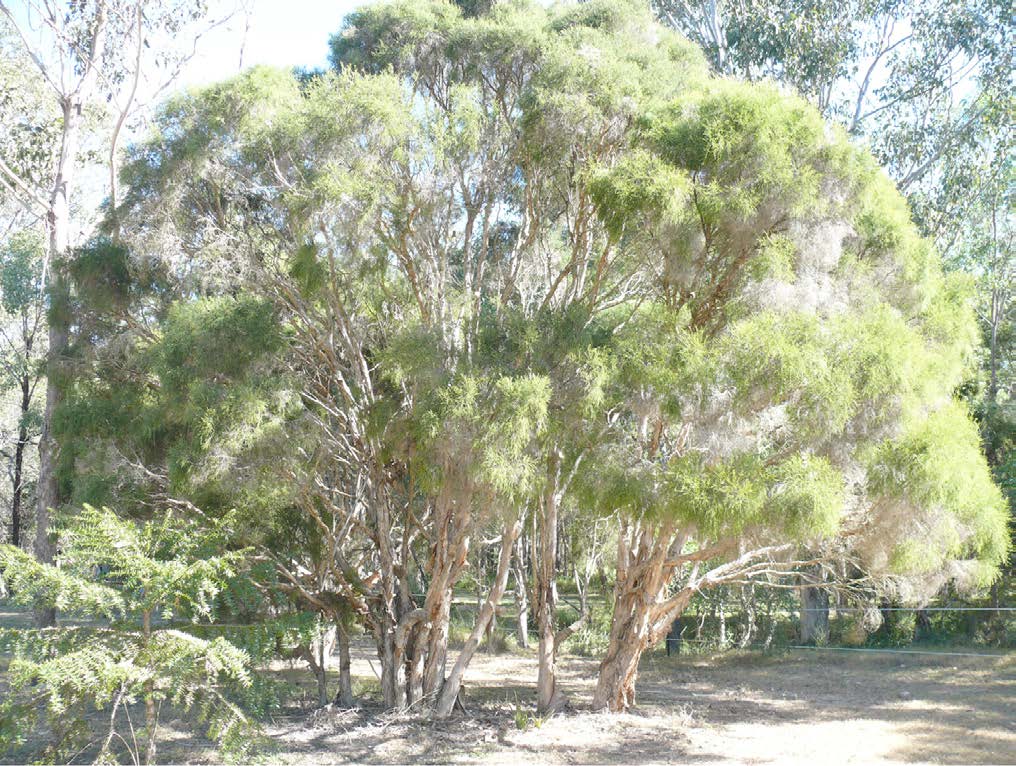
Swamp tea tree (Melaleuca irbyana) leaves that are tiny, stalkless, green and pointed.
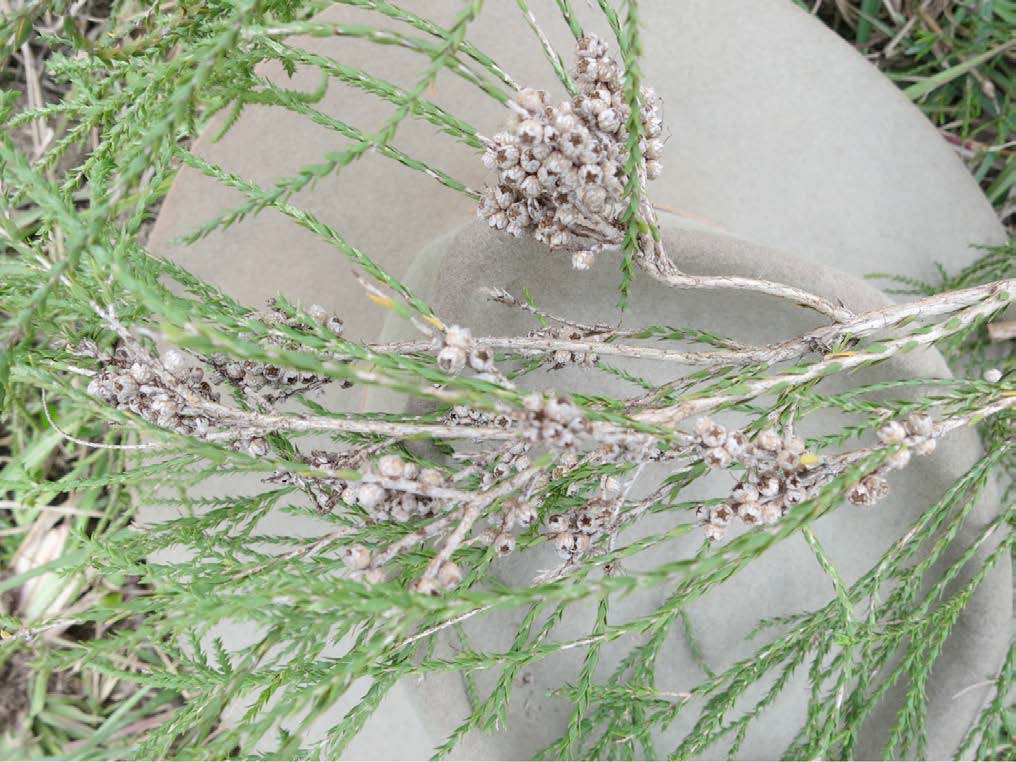
Swamp tea tree (Melaleuca irbyana) leaves

Ecological communities
Melaleuca irbyana forms two types of communities:
- Common form: Dominant Eucalypt canopy with Melaleuca irbyana thickets in the understorey
- Less common form: Open forest or thicket of Melaleuca irbyana with emerging Eucalypts and sparse understorey (grasses, sedges, herbs, shrubs, vines, orchids).
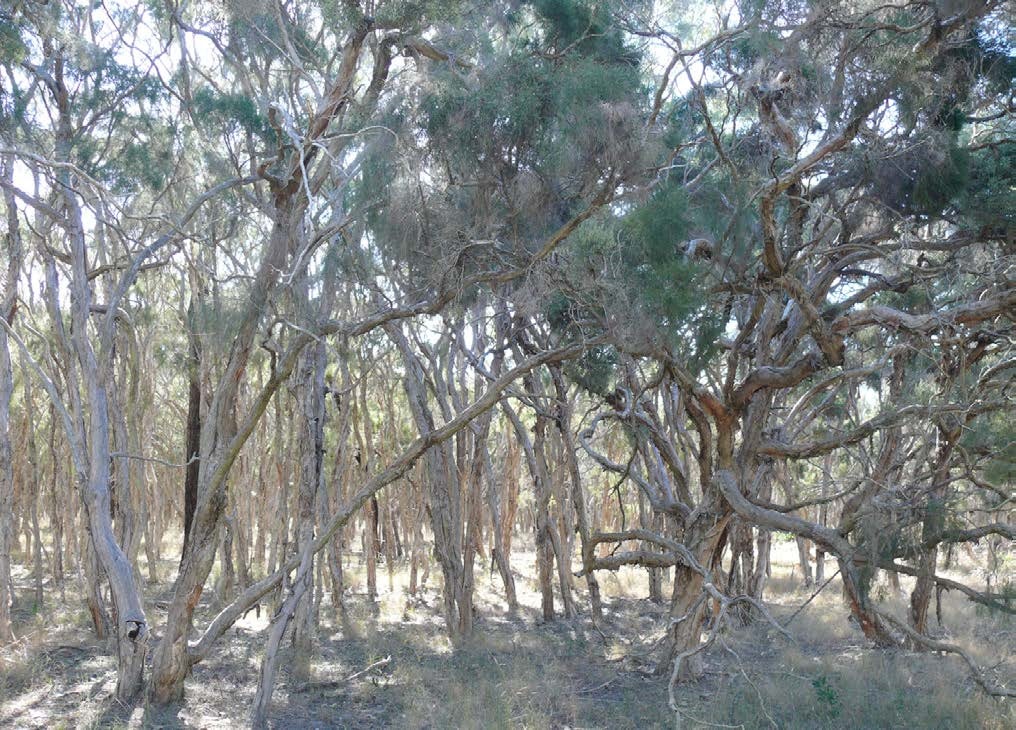
A Melaleuca irbyana community is defined as:
- a patch size of 0.25 hectares or greater, or
- multiple patches less than 0.25 hectares, separated by 25 metres or less, with a combined area greater than 0.25 hectares, and
- trees at least 2 metres tall,
- where Melaleuca irbyana forms at least 50 per cent of the primary canopy or at least 5 per cent of the subcanopy.
Our definition is based on the Melaleuca irbyana Community Mapping Project (Ryan, 2010).
Threats to swamp tea tree communities:
- Changes in surface water runoff and infiltration
- Edge effects, including:
- weed invasion (e.g. Rhodes Grass, Guinea Grass, Giant Rat’s Tail Grass)
- increased wind, evaporation, solar radiation and temperature
- Nutrient increases (e.g. nitrogen)
- Soil compaction and grazing
- Intense, frequent fires
- Land clearing for development
- Climate change impacts (e.g. altered fire regimes and hydrology)
How can we protect swamp tea tree
- Maintain a hydrological buffer.
Avoid earthworks and impermeable surfaces within 150 metres of communities (especially within 50 metres).
- Minimise hydrological changes if works are unavoidable. Keep impervious surfaces less than 25 per cent within the buffer. Ensure the first 10 millimetres of daily runoff is infiltrated into native soils.
- Remove invasive weeds from within and at least 50 metres around communities.
- Avoid planting invasive garden species near communities.
- Minimise nutrient input. No effluent irrigation or fertilisers within 50 metres.
- Restrict grazing. Prevent stock from entering communities.
- Avoid horse riding trails through communities.
 We can proactively improve the health and extent of the swamp tea tree community by:
-
Maintaining a 50 metre buffer to reduce edge effects
Establish and maintain weed-free vegetation buffers around swamp tea tree
communities to mitigate "edge effects". In the absence of detailed research,
a minimum buffer width of 50 metres is recommended as a guideline.
-
Revegetating where buffers are absent
If no vegetation buffer exists (e.g. only grassed areas), revegetate a 50 metre zone around the community using appropriate planting densities and species
(including Melaleuca irbyana and associated species) that align with
the regional ecosystem. Use locally sourced stock from nurseries operating
under relevant permits (e.g. Logan-sourced plants).
-
Avoid mowing within and around communities and individual plants
Refrain from mowing in these areas to support the survival of new
Melaleuca irbyana and other native species. This practice can form part
of an “assisted natural regeneration” approach to establishing a 50 metre vegetation buffer around the community.
Need help conserving swamp tea tree?
Council can provide advice on how to protect and restore swamp tea tree communities, including recommended species for buffer planting and tips for weed control.
You may also be eligible to join Council’s free Environmental Conservation Partnerships Program, which offers great benefits such as access to EnviroGrants. These grants have previously funded projects to remove weeds and rehabilitate swamp tea tree habitats on private properties.
For more information about conserving swamp tea tree (Melaleuca irbyana), applying for EnviroGrants, or joining the Environmental Conservation Partnerships Program, email environment@logan.qld.gov.au.
Further research
There is much that we still need to learn about Melaleuca irbyana. Finding out more can help us refine mapping and identify potential future habitat for revegetation. Key areas of future research could include:
-
Exploring swamp tea tree dependence on groundwater and aquifers
Understanding the relationship between swamp tea tree and groundwater is
essential. If the species relies on groundwater, it is critical to identify
and protect aquifer recharge areas from development. These areas may include:
- Small wetlands
- Streams
- Natural depressions where water pools
- Areas with a high perimeter-to-volume ratio
-
Impacts from lowered catchment permeability
Understanding how development and catchment impermeability affect factors
that influence swamp tea tree growth and survival, including:
- Water table levels
- Amount of run-off
- Sedimentation
- Water flow
- Soil compaction
-
New tree growth
Improved understanding of the general growth and reproductive output of
newly established swamp tea trees.
Improved understanding of how individual and scattered swamp tea trees
growing around urban infrastructure contribute to maintaining genetic
variation.
You can find out more about the Swamp tee tree (Melaleuca irbyana) from the Australian Government Department of Climate Change, Energy, the Environment.
References
- Melaleuca irbyana Recovery Plan Review, prepared for Logan City Council, Francisii Ecology 2023.
- Department of Sustainability, Environment, Water, Population and Communities (2012). Swamp Tea-tree (Melaleuca irbyana)
- Forest of South-east Queensland in Community and Species Profile and Threats Database, Department of Sustainability, Environment, Water, Population and Communities, Canberra.
- Ryan, T. S. (2010) Melaleuca irbyana (swamp tea-tree) Community 1:25,000 Scale Mapping Project. Department of Environment and Resource Management, Brisbane.