Traffic calming devices
Traffic calming devices are installed to help enforce speed limits and deter non-local traffic from using the road as a racetrack to avoid lights. They are not designed to eliminate reckless driving like hooning.
Often the type of devices used, such as speed humps and chicanes, tempt irresponsible drivers to treat the devices as a challenge. Rather than calming, they can result in increased noise and hooning behaviour.
When considering if traffic calming devices are appropriate we investigate things like:
- crash history
- vehicle speeds (and how many vehicles are travelling above the speed limit)
- how installation of traffic calming devices on one street will affect surrounding streets
- do the residents in the street (in particular those near the proposed device location) support the installation of traffic calming devices.
As traffic calming is expensive and funds are limited, it can only be provided in a select number of locations with the greatest need.
Local area traffic management
Local area traffic management is also called traffic calming. Traffic calming involves changing the road in certain areas to:
- physically control and reduce vehicle speeds
- provide a safer environment for pedestrians and cyclists, and
- discourage non-local traffic
Traffic calming will not resolve all traffic concerns and isn’t designed to prevent reckless driving like hooning.
A typical residential street has a default speed limit of 50km per hour where the majority of traffic is local (residents who live in the area). Not all residential areas warrant the installation of traffic calming.
Rural residential areas
In rural residential areas, it is more difficult to install traffic calming devices as there is no kerb and channel to control where motorists drive. Devices are not normally installed on roads with speed limits over 50km per hour.
Types of traffic calming devices

Speed humps and platforms
Speed humps and platforms can be installed in suitable locations in streets where traffic surveys have identified continual speeding as an issue.

Traffic islands
Physical traffic control devices like concrete islands can be used to separate traffic at intersections and to provide a refuge for pedestrian crossing points on wide roads.
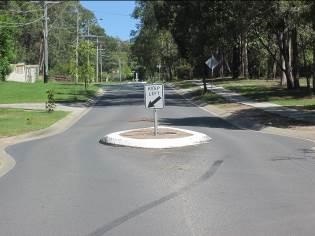
Chicanes
Chicanes are installed in streets with long sections of straight road to slow traffic speeds, often as part of new developments.
Safety barriers and bollards
Safety barriers and bollards are installed to protect motorists from a hazard adjacent to the road. They are generally the last choice if the hazard cannot be removed, relocated or reduced in severity. They are not designed to stop motorists who are speeding or to protect a resident’s property. Bollards are sometimes used to prevent parking on the nature strip as this can damage underground services.
Removal of traffic calming devices
Removing or modifying a traffic calming device can result in motorists travelling at higher speeds. Often traffic calming devices are installed as part of a new development or where speeding issues have been identified and their effectiveness is compromised if the devices are removed or modified.