Borrol is a Yugambeh word that means mountain range or mountain peak.
The Yugambeh, Turrbal and Jagera peoples were the three core Indigenous language groups based in the Logan River catchment. The kinship group who lived in the area now known as Yarrabilba spoke the Yugambeh (Yoo-gum-bear) language. “Based to the south of the Logan River, the sea formed their border to the east and the Tweed River to the south”. (Jabree Limited, 2018, p. 12)
Borrol Lookout is named to reflect its location on top of a rocky outcrop, with wonderful views of nearby ridges and mountain ranges.
For the best views in the park, climb the path to the Plunkett Mallee shelter and way-finder. From there, you can see the peaks of the Birnam Range and identify them using the lookout sign. Follow the view-line marked by the carved totem to find Bingingerra (Mount Witheren).
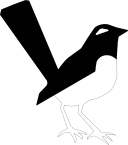
To learn about the creation story of Bingingerra, view the Story of Bingingerra and look for the story signs marked by the Willie Wagtail, starting at the picnic shelter.
Thank you to Jabree Ltd, the cultural heritage body for Yarrabilba, for sharing the creation story of Bingingerra.
(Photo courtesy of RPS)
“Bora Rings represent locations where Aboriginal groups conduct ceremony including… initiation ceremonies for young men. This ceremony forms the rite of passage for boys to become men. It is such a significant cultural marker or event within a family” (Jabree Limited, 2018, p. 16)
At the top of the sandstone outcrop on the western side of the lawn, follow the path to a circle of boulders among the trees. This special area of Borrol Lookout celebrates the Bora Ring story.
Long before this area became a park or was known as Yarrabilba, it is believed that people could hear the singing and clapping from corroborees from this lookout point.
The Bora Grounds located throughout the Albert River catchment, Mount Tamborine and the Yarrabilba area, “continue to be of high significance to Aboriginal people living in the region.” (Jabree Limited, 2018, p. 4)
Today, this area provides a space where local school groups can gather and take part in outdoor learning activities.
(Photo courtesy of Lendlease)
Find out more information by visiting Preserving Country and Cultural Heritage at Yarrabilba.
What does it mean for a place to have high “cultural value” to Australia’s Traditional Owners?
According to the Cultural Heritage Assessment Report YPDA by Jabree Limited, the cultural heritage body for Yarrabilba:
“Social/Cultural value refers to the spiritual, traditional, historical or contemporary associations and attachments the place or area has for Aboriginal people how people express their connection with a place and the meaning that place has for them.” (Jabree Limited, 2018, p.41)
Borrol Lookout (previously referred to as South Rock) is one such place identified in the report to have high cultural value. This is due to the site’s aesthetic value as a sandstone outcrop which “affords a 360-degree vantage point to all significant ridges and places in the local landscape” and the recovery of 62 Aboriginal artefacts thereby “demonstrating evidence of occupation”. (Jabree Limited, 2018, p. 31, 40, 43, 49-50).
“a single artefact/object can be confirmation of an Aboriginal person’s connection with country.” (Jabree Limited, 2018, p.42).
(Photo courtesy of Lendlease ‘Yarrabilba place of song’, Archaeological work on-site unearthing Aboriginal artefacts at Yarrabilba, 2011).
The way-finding dial imprinted on the ground at the lookout shelter shows other culturally significant sites in and around Yarrabilba. Inspired by the endemic Eucalyptus Curtisii (Plunkett Mallee) flower, the stamens point to the location of these features. Follow the direction of the dial to visit other Yarrabilba sites such as The Rock Shelters and the Jinnung Jalli Interpretive Trail.
(Photo courtesy of Lendlease ‘Yarrabilba place of song’, Archaeological work on-site unearthing Aboriginal artefacts at Yarrabilba, 2011).
In 2011, prior to the residential development of today, Lendlease Communities, Yarrabilba, engaged Jabree Limited to undertake a cultural heritage assessment of the Yarrabilba Priority Development Area (YPDA) and develop a series of heritage assessment reports.
These reports were presented in the form of the Jabree Limited Cultural Heritage Assessment Summary Report – YPDA-2011-2017 to aid with management strategies to identified Aboriginal sites.
Report findings:
Despite the high levels of disturbance to the Yarrabilba area during its time as the Camp Cable Army base and later as a pine plantation, some 1,859 stone crafted Aboriginal artefacts were recovered during the study’s excavation.
The Report found high cultural heritage significance to areas where artefacts were found in association with important landscape features and ecology.
(Jabree Limited, 2018, p.4)
Report Recommendations – Protecting South Rock
One such place identified in the Report as a place of high cultural heritage significance was the sandstone outcrop known as “South Rock”.
Jabree Limited requested that Lendlease protect and conserve the “hillock at South Rock” as part of the Yarrabilba development for its “high cultural and aesthetic value to the traditional owners represented by Jabree Limited”. (Jabree Limited, 2018, p.5 & 51).
(Photo courtesy of RPS).
It was “proposed that an interpretive display of Aboriginal cultural heritage be established in the YPDA as part of the Lendlease development’s overarching “Art Strategy” … and that “an interpretive display in a residential area would provide a rare and important opportunity to educate and engage the public in Aboriginal history, archaeology and culture and provide an opportunity for reconciliation and cross-cultural connections.” (Jabree Limited, 2018, p.5).
The creation story of Bingingerra (Mount Witheren), the sound of corroboree at the stone circle, the Yugambeh word for mountain ridge Borrol, even this very webpage, all forms a very unique interpretive experience in the heart of Yarrabilba
As you explore and play at Borrol Lookout, look out for the signs with the Willie Wagtail to follow the creation story of Bingingerra (Mount Witheren), an epic battle between land and sea animals as shared by Jabree Ltd.
A very long time ago when many of the mountains we are so familiar with today were still being made and the animals and birds were much larger than they are now, there was much anger felt by the land animals with the sea animals, for the latter frequently made visits ashore and trespassed on the land animals’ territory. The land animals held a great meeting which was made possible by Willie Wagtail, a friendly talkative little bird with boundless energy, and he contacted all the land animals and birds.
Amongst those present were the Sand Goanna known as "Maroon" the flying squirrel from "Wyambyn", [weem means flying squirrel], the copper snake from "Kooralbyn" [guralbang means brown snake] and many others too numerous to mention! The meeting decided to attack the sea animals next time they ventured ashore, and it was decided to appoint "Bingingerra" [binging means turtle] the giant freshwater turtle to be their leader for he, although slow, was very sure and determined and his hard shell afforded his good defence against attack. The great battle took place, and the sea animals were driven back far out to sea never to return to the territory of the land animals.
Unfortunately, such a great battle was not without is causalities! Poor old Sand Goanna suffered mortal wounds, but before he died, he crawled inland to the base of the Great Dividing Range and his body after turning into rock formed what is now known as Mount Maroon. The Koala bear was in the thick of the fighting and when he discovered that not even a stump remained where once grew his lovely bushy tail he climbed up a great gum tree, placed himself in the form made between the main trunk and a large branch and just cried and cried and to this very day seldom comes down for a drink and mainly lives on the leaves of the gum trees and whenever frightened or hurt still cries like a human baby.
The little bird that we know today as the Blood Bird or Mistletoe Bird and can frequently be seen feeding upon the mistletoe in the trees did not always
have that vivid red breast. He became saturated with blood when giving much care and attention to Bingingera who had suffered many terrible wounds and he [the Blood Bird] retains those vivid blood-coloured feathers to this very day.
Poor Bingingerra made a noble effort to make his way back from the seashore when all the fighting was done - to his home in the lagoons along the Albert River, but his life was slowly ebbing away and when a short distance from home he lay down with his neck stretched out to have a long sleep from which he never awoke. Like Maroon his body turned to stone and that is how Mount Bingingerra [Mount Witheren] was made in the shape of a great turtle at rest.
- Jabree Limited. (2018). Cultural Heritage Assessment Summary Report 2011-2017 Yarrabilba Priority Development Area. Jabree Limited.
- Jabree Limited. (2018). Unique Cultural Heritage at Yarrabilba.
- Jabree Limited. (2019). Yarrabilba Art & Wayfinding Strategy: Aboriginal Cultural Heritage Interpretive Stories, Naming and History.